European Outdoor Cities
Standards

A transparent framework for outdoor sport close to home

Explore four pillars, 12 categories and 65 indicators that help cities and municipalities understand and strengthen the conditions for outdoor sport and recreation.

Explore the 12 categoriesStart the Quick Check

The framework

The framework behind European Outdoor Cities

The European Outdoor Cities Standards provide a shared structure for understanding the conditions that support outdoor sport and recreation in urban and peri-urban areas.

They help cities and municipalities see the whole system: natural conditions, outdoor infrastructure, inclusive participation, strategy, investment and the organisations that create outdoor opportunities.

How the framework is organised

From four pillars to practical indicators

The framework moves from broad orientation to specific topics for reflection. Each level adds detail while remaining connected to the wider European Outdoor Cities system.

Pillars

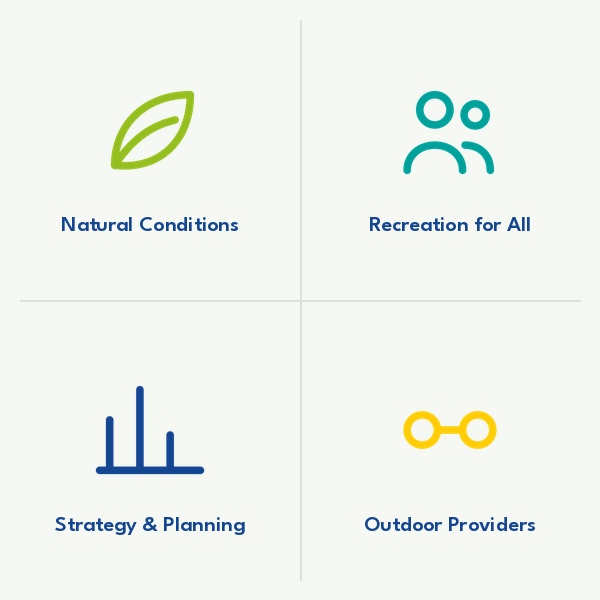
Four pillars provide the main orientation across the framework.

Categories

Twelve categories describe the core areas of municipal outdoor development.

Indicators

Sixty-five indicators translate each category into specific topics that cities and municipalities can examine.

4
pillars
12
categories
65
indicators

Four equal pillars

A shared orientation across European Outdoor Cities

The same names, numbers and order are used across the Quick Check, Standards and Good Practices, making it easier to move from first orientation to deeper understanding and practical examples.

Pillar 1

Pillar 1 · Categories 1–4

Natural Conditions and Outdoor Infrastructure

Protect natural environments and provide safe, accessible and well-managed places for outdoor sport and recreation.

Explore Pillar 1

Pillar 2

Pillar 2 · Category 8

Outdoor Sports and Recreation for All

Understand and remove barriers so people of different ages, backgrounds and abilities can participate.

Explore Pillar 2

Pillar 3

Pillar 3 · Categories 5–7

Strategy, Planning and Investment

Embed outdoor sport in policy, knowledge, communication, cooperation and long-term resources.

Explore Pillar 3

Pillar 4

Pillar 4 · Categories 9–12

Outdoor Sports Providers

Strengthen the public, private and community organisations that create and deliver outdoor opportunities.

Explore Pillar 4

Explore the Standards

12 categories and 65 indicators

Browse the Standards by pillar. Open a category to understand why it matters, what it covers and which indicators belong to it.


Pillar 1 · Categories 1–4

Natural Conditions and Outdoor Infrastructure

1 · Natural Conditions and Nature Protection · Pillar 1 · 6 indicators

Why it matters

Natural environments are the foundation of outdoor sport and recreation. Protecting and strengthening them supports activity, wellbeing, nature connection and long-term availability of outdoor opportunities.

What it covers

Availability, quality, protection and development of natural areas: existing and protected areas, valued characteristics, conservation and restoration, new natural spaces and climate adaptation.

6 indicators

  • 1.1 Existing nature areas
  • 1.2 Existing protected natural areas
  • 1.3 Nature areas with valued characteristics for outdoor sports
  • 1.4 Protection, conservation and restoration of nature
  • 1.5 Transformation of land use to new natural areas
  • 1.6 Climate considerations and climate adaptation measures

Explore related Good Practices

2 · Outdoor Infrastructure and Management · Pillar 1 · 9 indicators

Why it matters

Natural spaces alone do not guarantee a good outdoor experience. Accessible, well-designed and maintained infrastructure determines how easily and safely people can take part.

What it covers

Trailheads and gateways, trail networks, activity hotspots, visitor monitoring, maintenance, sustainable operation, responsible land use and managed access in protected areas.

9 indicators

  • 2.1 Welcoming and safe trailheads and gateways
  • 2.2 Quantity, quality and variety of trails
  • 2.3 Hotspots for outdoor activities
  • 2.4 Visitor monitoring
  • 2.5 Maintenance of outdoor sport infrastructure
  • 2.6 Maintenance of supporting facilities
  • 2.7 Sustainable operation of infrastructure
  • 2.8 Sustainable land use and environmental practices
  • 2.9 Sustainable outdoor sport in protected areas

Explore related Good Practices

3 · Safety Procedures and Risk Prevention · Pillar 1 · 3 indicators

Why it matters

Safety is a basic condition for participation. Clear procedures and reliable information reduce avoidable risks and increase confidence, especially for beginners, families and visitors.

What it covers

Safety planning, emergency preparedness, risk communication, incident reporting and learning, and routines for closing, repairing or reopening unsafe infrastructure.

3 indicators

  • 3.1 Safety and rescue plans
  • 3.2 Incident reporting and safety feedback
  • 3.3 Routines for correcting dysfunctional infrastructure

Explore related Good Practices

4 · Access to Nature and Facilities · Pillar 1 · 8 indicators

Why it matters

The presence of nature and facilities does not automatically mean people can use them. Distance, transport, cost, regulation, unfamiliarity and inaccessible information can all prevent participation.

What it covers

Proximity, supportive access regulations, equipment availability, public transport and active mobility, parking and equipment transport, and reducing social, cultural, physical and economic barriers.

8 indicators

  • 4.1 Distance to nature and outdoor sport facilities
  • 4.2 Good regulations on access
  • 4.3 Easy access to outdoor sports equipment for all
  • 4.4 Understanding and addressing other barriers
  • 4.5 Good public transportation to infrastructure
  • 4.6 Infrastructure for active commuting
  • 4.7 Parking areas near facilities and nature
  • 4.8 Equipment transportation on public transport

Explore related Good Practices


Pillar 2 · Category 8

Outdoor Sports and Recreation for All

8 · Outdoor Sports and Recreation for All · Pillar 2 · 3 indicators

Why it matters

Outdoor sport should be accessible to people of different ages, backgrounds, abilities and circumstances. Physical access is only one part; confidence, affordability, welcome and representation also matter.

What it covers

Whether municipalities set clear ambitions for participation, provide inclusive initiatives and offer infrastructure for beginners, experienced users and people with different support needs.

3 indicators

  • 8.1 Clearly formulated ambitions for participation for all
  • 8.2 Inclusive outdoor sports initiatives
  • 8.3 Infrastructure and facilities for all levels of experience

Explore related Good Practices


Pillar 3 · Categories 5–7

Strategy, Planning and Investment

5 · Strategy, Planning and Investment · Pillar 3 · 10 indicators

Why it matters

Outdoor sport does not develop by chance. Long-term progress depends on political commitment, strategic direction, coordination across policy areas and resources beyond individual projects.

What it covers

How outdoor sport is embedded in policies, spatial planning, organisational responsibilities and stakeholder structures — plus dedicated staff, cooperation and public/private funding.

10 indicators

  • 5.1 Strategy decided in policies, masterplans or governing papers
  • 5.2 Dedicated staff for outdoor sports
  • 5.3 Integration into spatial planning
  • 5.4 Inter-departmental stakeholder forum
  • 5.5 Permanent organisation of stakeholders
  • 5.6 Involvement in specific projects and programmes
  • 5.7 Self-organised communities outside sport clubs
  • 5.8 Cooperation across municipalities, regions and the EU
  • 5.9 Funding secured and allocated
  • 5.10 Funding from different stakeholders

Explore related Good Practices

6 · Knowledge, Education and Training · Pillar 3 · 7 indicators

Why it matters

Successful outdoor development depends on knowledge and the ability to learn — decision-maker awareness, evidence about needs, and the skills to deliver safe, inclusive and sustainable opportunities.

What it covers

Awareness among decision-makers and citizens, evaluation of facilities and initiatives, needs mapping, knowledge exchange, professional competence and volunteer education.

7 indicators

  • 6.1 Decision-makers aware of the benefits
  • 6.2 Raising awareness among citizens
  • 6.3 Evaluation of facilities, projects and initiatives
  • 6.4 Mapping and needs analysis
  • 6.5 Sharing knowledge, experiences and ideas
  • 6.6 Trained instructors and professional providers
  • 6.7 Formal education for volunteers

Explore related Good Practices

7 · Communication and Events · Pillar 3 · 5 indicators

Why it matters

People are more likely to participate when they know what is available, how to reach it and what to consider. Communication strengthens identity; events introduce new audiences and activate public spaces.

What it covers

Communication strategies, printed and digital information, maps and live status systems, accessible information for different groups, and events that encourage participation.

5 indicators

  • 7.1 Communication strategy for the outdoor area
  • 7.2 Analogue material, web and social media
  • 7.3 Digital services, online maps and status systems
  • 7.4 Information accessible to all
  • 7.5 Outdoor sports events

Explore related Good Practices



Pillar 4 · Categories 9–12

Outdoor Sports Providers

9 · Professional Services · Pillar 4 · 2 indicators

Why it matters

Guides, instructors, equipment providers and accommodation businesses add expertise, services and capacity — introducing newcomers, supporting tourism and contributing to infrastructure and events.

What it covers

The presence of professional outdoor providers and how they contribute to local outdoor sport beyond their core commercial activities.

2 indicators

  • 9.1 Professional providers in a city or area
  • 9.2 Professional providers contribute to outdoor sports locally

Explore related Good Practices

10 · Civil Society, Communities and Voluntary Sports Clubs · Pillar 4 · 4 indicators

Why it matters

Civil society is often the first point of entry into outdoor sport. Clubs, volunteers and self-organised groups create activities, share skills, maintain places and build social connections.

What it covers

The range and inclusiveness of clubs, self-organised communities outside club structures and the contribution of volunteers to infrastructure, facilities and activities.

4 indicators

  • 10.1 Clubs providing different types of outdoor sport
  • 10.2 Clubs for all levels and all parts of society
  • 10.3 Self-organised communities outside sport clubs
  • 10.4 Volunteers helping create and maintain infrastructure

Explore related Good Practices

11 · Public Sector Providers · Pillar 4 · 7 indicators

Why it matters

Schools, early-years settings, health and care services can connect people with nature at different stages of life — supporting education, physical and mental health, inclusion and quality of life.

What it covers

How public institutions use nature and outdoor learning in kindergartens, schools, health promotion, rehabilitation and elderly care, plus the staff competence and facilities needed.

7 indicators

  • 11.1 Nature pedagogy in kindergartens
  • 11.2 Nature pedagogy in schools
  • 11.3 Nature pedagogy in high schools
  • 11.4 Nature and outdoor activities in elderly care
  • 11.5 Outdoor activities in public health care
  • 11.6 Capacity building for public welfare in nature
  • 11.7 Facilities to support public welfare in nature

Explore related Good Practices

12 · Other Support · Pillar 4 · 1 indicator

Why it matters

No common framework can anticipate every local idea. Recognising creative, place-specific contributions keeps the Standards flexible and supports the exchange of emerging good practice.

What it covers

Space for municipalities to describe additional support, initiatives or achievements not adequately represented in the other categories.

1 indicator

  • 12.1 Any other support given for outdoor sports and recreation

No directly connected Good Practice is available for this category yet. Explore examples from the wider pillar.

Explore Good Practices for this pillar

Principles

Designed to support progress, not prescribe one model

European municipalities differ in geography, governance, resources and outdoor culture. Eight shared principles guide the framework and its application.

Inclusive and relevant

Applicable across different European contexts, governance systems and levels of outdoor development.

Easy to use and flexible

Reasonable demands on time and expertise, with value for first steps and mature systems alike.

Learning and progression

Encourages reflection, repeated use and visible improvement over time.

Exchange of good practice

A shared language for learning between municipalities and documenting adaptable approaches.

Strategic relevance

Supports political and administrative decisions, prioritisation and coordination across sectors.

User-centred and collaborative

Development informed by residents, user groups, associations and cross-sector cooperation.

Credible and transparent

A clear structure and understandable indicators without oversimplifying local contexts.

Long-term and balanced

Integrates nature protection, accessibility, sustainability, maintenance and responsible use.

From framework to practice

Turn areas for development into practical next steps

The Standards show what cities and municipalities should consider. Good Practices show how comparable questions are being addressed in practice across Europe.

Quick Check

First step · Orientation

Find out where your municipality stands

Nineteen questions across the four pillars give an immediate qualitative snapshot — about ten minutes, no registration and no preparation needed.

Start the Quick Check

Good Practices

Next step · Inspiration

See how comparable questions are solved elsewhere

Examples from municipalities across Europe, connected to the same pillars and categories — to adapt locally, not to copy one-to-one.

Explore Good Practices

Developed through STANDOUT

Built from research, co-creation and practical testing

The European Outdoor Cities Standards were developed and tested through the STANDOUT Erasmus+ Sport project together with municipalities, public authorities, researchers and outdoor sport organisations from across Europe.

Teilnehmende der II. Knowledge Exchange in Lecco im Freien
13
workshops
12
cities
148
participants
70
Good Practices
20
labels reviewed
3
pilot municipalities

Research

Workshops, existing Good Practices and European labels and frameworks helped identify barriers, drivers and relevant areas of municipal action.

Co-creation

Partner working groups, expert input and five Knowledge Exchanges translated evidence and experience into pillars, categories, indicators and guidance.

Pilot testing

Viana do Castelo, Silkeborg and Sundsvall tested clarity, relevance and practical application in different municipal contexts.

Finalisation

Pilot feedback informed the final wording, structure and guidance of the Standards.

Get more information and updatesLearn more about ENOS

Resources & FAQ

Work with the complete framework

Explore the Standards online or use the published resources for the complete framework, background and implementation guidance.

What are the European Outdoor Cities Standards?

The Standards are a public European framework describing the conditions that support outdoor sport and recreation in cities and municipalities. They are organised into four pillars, 12 categories and 65 indicators.

Are the Standards publicly available?

Yes. The criteria are intended to be transparent and useful to cities and municipalities at different stages of development.

Are the Standards a certification or ranking?

No. The Standards themselves do not certify, rank or compare municipalities. They provide a shared framework for reflection, discussion and continuous improvement.

Who should work with the Standards?

Municipal decision-makers and staff are the primary users, but the process benefits from input by public institutions, outdoor organisations, clubs, communities, businesses and nature managers.

Does every indicator apply in every municipality?

Not necessarily. The framework is designed for different geographical, cultural and governance contexts. Municipalities should use professional judgement and focus on meaningful local interpretation.

Do we need complete data for every indicator?

No. Use the best available information. Missing or uncertain information can reveal where further dialogue, monitoring or cooperation may be useful.

How do the Standards relate to the Quick Check?

The Quick Check provides a first qualitative snapshot through 19 questions across the four pillars. The Standards provide the complete structure behind that first orientation, with 12 categories and 65 indicators.

How do the Standards relate to the European Outdoor Cities Network?

The Standards are public and do not require Network participation. The European Outdoor Cities Network is being developed for cities and municipalities that want to exchange experience, work more systematically with the framework and stay connected to the next stages of the programme.

Can the Standards be used more than once?

Yes. Returning to the framework can help municipalities review progress, refresh priorities and respond to changing local conditions.

Resources

Explore the Standards online

All four pillars, 12 categories and 65 indicators are available on this page.

All project resources as PDF

The published Standards, the implementation guidance and every other project report — eight documents to download.

Get more information and updates

Leave your details and we will let you know when new resources and publications become available.

Start with your city

Use the Quick Check for a first qualitative orientation. Then return to the Standards to understand your results and explore Good Practices connected to your development priorities.

Start the Quick CheckExplore Good Practices